
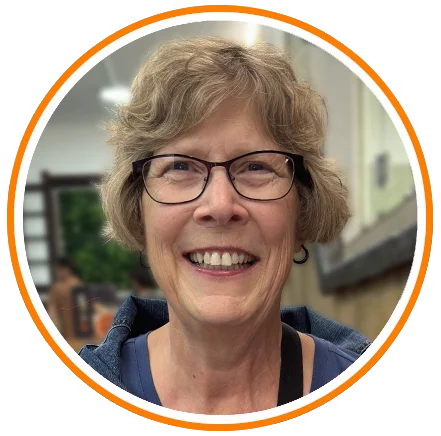
Linda’s story
Flat back deformity, scoliosis
Surgery with Dr. Tempel helped restore Linda's quality of life
Linda remembers neurosurgeon Dr. Zach Tempel sitting across from her, telling her how her journey through spinal deformity surgery was about to proceed.
There would be months of preparation and diagnostic tests, including medication to treat Linda's osteoporosis. The surgery itself would come in two phases, with several days in intensive care. The recovery could take up to a year before Linda would regain full mobility.
"Dr. Tempel said to me, 'I think I can improve the quality of your life," Linda recalls now. "'The journey is going to be long, and it's going to be hard. I'm willing to go on that journey if you're willing to put in the effort.' That really stuck in my brain. I really didn't have that much quality of life."
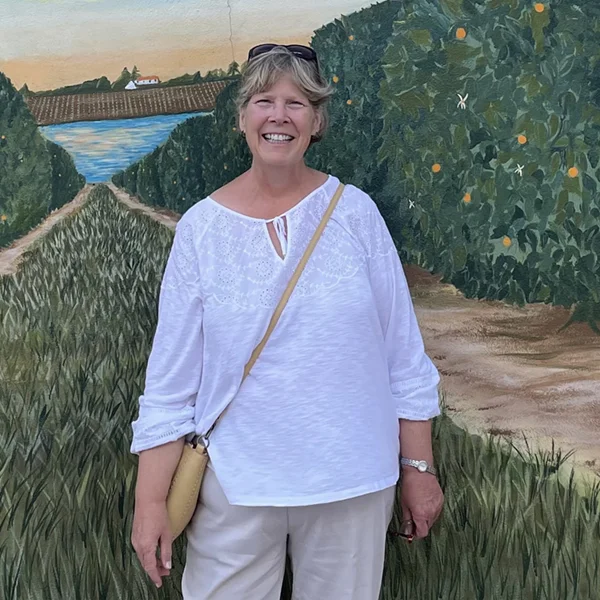
Linda's back problems started more than two decades ago. She went through plenty of injections and physical therapy sessions. But none of those could solve her core medical challenge: a spine with severe deformities that had her hunched over at the shoulders but nearly straight in the middle of her back where it should curve inwards. That was causing enough pressure that some of the vertebrae had effectively fused together, making it both more rigid and more difficult to correct.
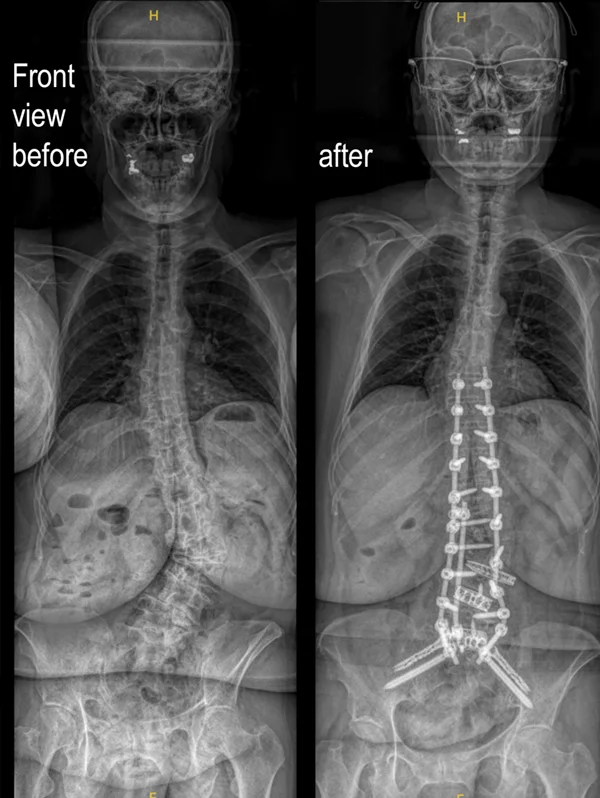
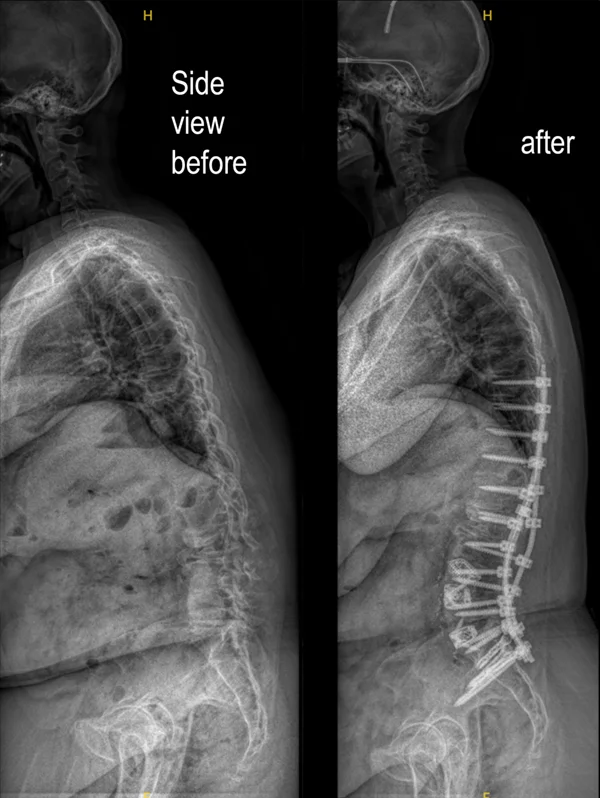
Dr. Tempel and Dr. Kachmann corrected the unnatural curvature of Linda's spine that was causing her back pain and other symptoms.
On top of that, Linda also suffered from scoliosis, an unnatural side-to-side curvature in the spine. This kind of spinal deformity can't be solved with surgery on just a few levels of the spine, Dr. Tempel says, but requires a more global solution.
"Linda's pain wasn't caused by one pinched nerve or one herniated disc," he says. "Her spine was shaped in a way that made it difficult to even stand up straight. This kind of deformity comes from her own anatomy and years of damage."
Eventually, it got to the point where Linda was sitting in a chair for most of her day. The pain extended from her lower back, through her buttocks and down the back of both legs.
"I had no capacity to walk or even stand for more than five minutes," she says. "Even getting out of bed was very painful. When I sat in a chair, I was OK."
Once Linda made the decision to proceed with the surgery, Dr. Tempel ordered an exhaustive series of tests: an X-ray for scoliosis, a magnetic resonance imaging scan on the lumbar spine, a myelogram to get clearer images of the spine, and a bone density test called DEXA. That test made clear that Linda's osteoporosis would need to be controlled before surgery, so she went on a six-month course of medicine to strengthen her bones.
Many of the spinal deformity surgeries at Mayfield are performed as a team. Dr. Tempel and neurosurgeon Dr. Michael Kachmann worked together on Linda's surgery to agree on the diagnosis and the optimal surgical plan, followed by the actual procedure.
After all of the tests and treatment, Linda underwent surgery at Good Samaritan Hospital. In the first phase of the operation, Dr. Tempel and Dr. Kachmann completed an anterior lateral interbody fusion, called ALIF, on the L4-S1 levels of Linda's spine, and a lateral lumbar interbody fusion, or LLIF, on the L3-L4 levels. The difference between the two surgeries is the access point: from the front (anterior) or from the side (lateral). In both procedures, the surgeons removed the discs and inserted spacers that would align those vertebrae properly. In the second phase a few days later, they straightened and stabilized the entire lower half of Linda's back, inserting hardware from the T9 level all the way down to the pelvis.
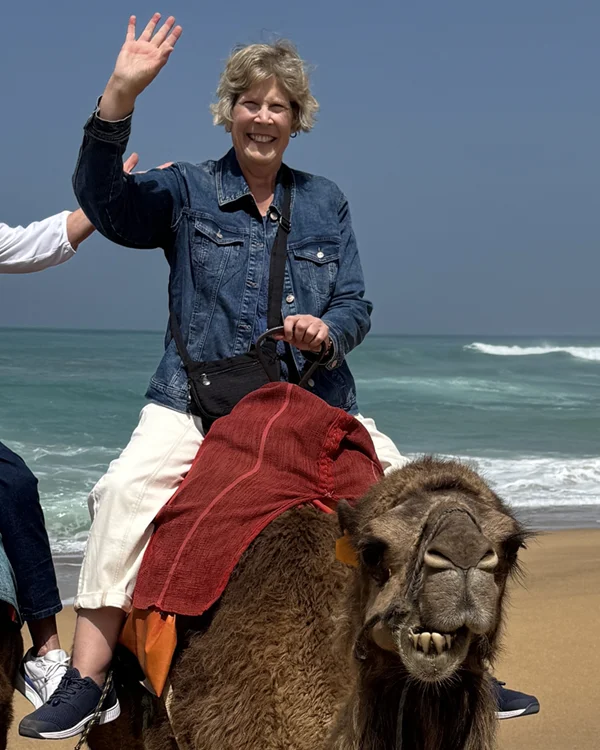
Linda at the beach, on a camel
Linda spent about 10 days in the hospital and another several weeks in a rehab facility. She worked with physical therapist Luke Iding and PT assistant Michael Kunz at Mayfield's Anderson office. Six weeks after the surgery, she reported that her pain was significantly lessened and she was starting to move around.
"Linda's courage and persistence have driven her successful surgery and recovery," Dr. Tempel says. "Spinal deformity surgery is a partnership between our medical staff, the patient and the patient's family. She was determined to return to the things she loves to do in life. As a surgeon, it is always gratifying to see that happen."
A year after the surgery, Linda was still not up to full activity level but felt like she was improving every day. Today, three years after the operation, she is "as active as a 71-year-old can be." She's traveled to destinations in Europe and beyond. She walks regularly and hangs out with her young nephew. She says she's at least an inch taller than she was before the surgery.
"You almost have to retrain yourself to walk," Linda says. "I'll tell you what I can do that I couldn't do before: I can stand tall, with my head held high."
~ Cliff Peale
Hope Story Disclaimer -"Linda's Story" is about one patient's health-care experience. Please bear in mind that because every patient is unique, individual patients may respond to treatment in different ways. Results are influenced by many factors and may vary from patient to patient.


 Click here to call 513-221-1100