
Dave's story
Stroke, mechanical thrombectomy
After suffering a stroke, Dave recovered quickly after surgery
Dave woke up in the intensive care unit and thought to himself, “I feel normal.”
“I was kind of like, ‘I’m fine. What’s all the hubbub about?’” he recalls now.
All the hubbub had started less than three hours earlier, when Dave suffered a stroke while at Sunday morning church services. He says his right hand “just felt a little different.”
“I just remember looking down at my hand and trying to put it into my pocket, and I couldn’t get it to do what I wanted,” he says. “Then my right leg just gave out.”
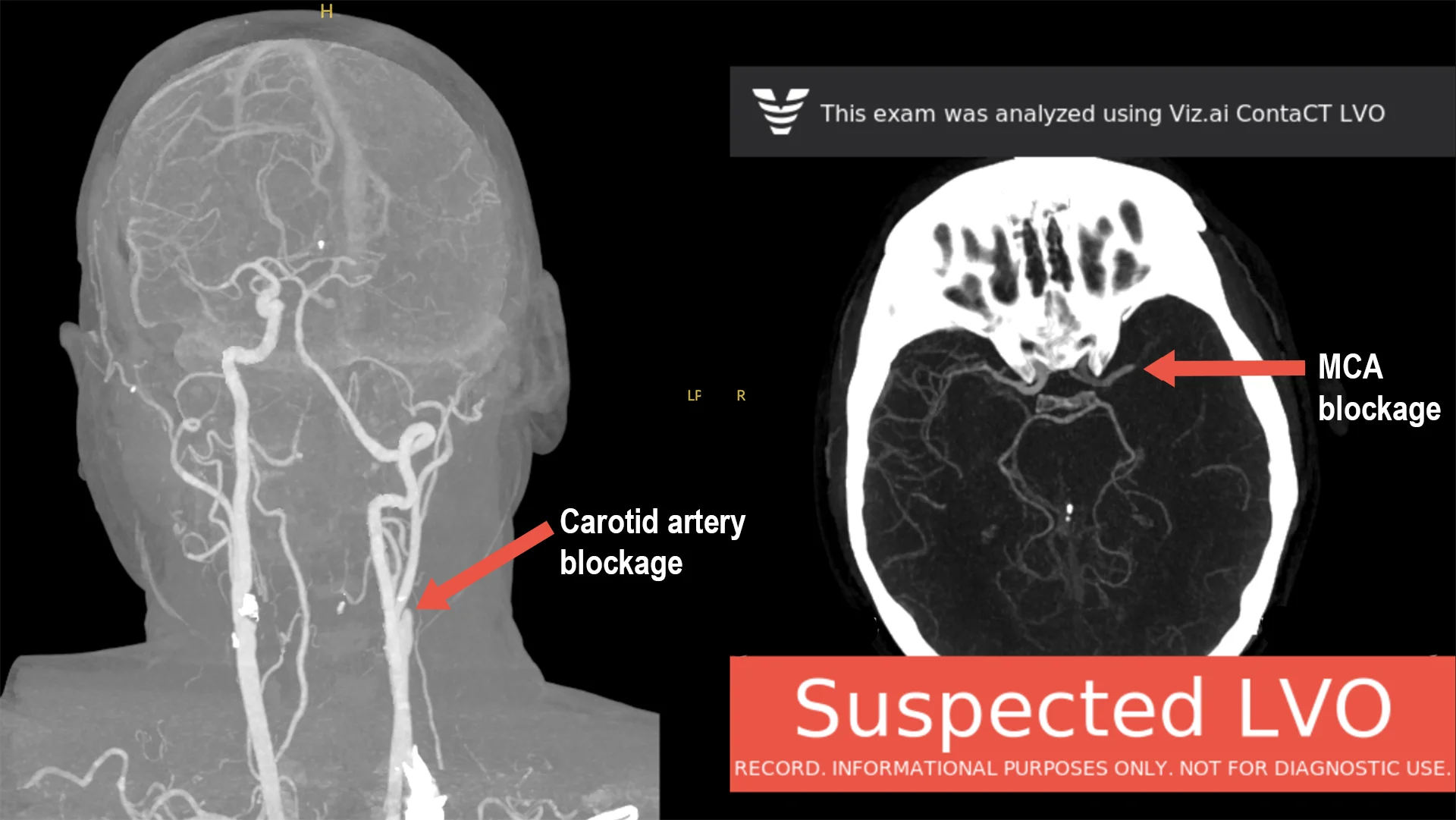
Surgeons had to clear a blockage in Dave's left interior carotid artery to reach the clot that was blocking his middle cerebral artery, then also remove that clot as well.
After a quick ambulance ride to the emergency room at Bethesda North Hospital, Dave underwent surgery with Dr. Michael Robinson, a neurosurgeon at Mayfield Brain & Spine. Only about 70 minutes after the stroke, Dr. Robinson operated to pull a blood clot out of Dave's left interior carotid artery that was completely blocking blood flow to his brain, and then removed a blockage in the middle cerebral artery as well. The endovascular procedure, called a mechanical thrombectomy, is performed through a catheter inserted in the patient's groin.
“Performing a thrombectomy was the fastest and most efficient way to clear that major artery leading to Dave’s brain,” Dr. Robinson says. “The fact that he was transported to the hospital so quickly and we were able to get that artery open likely prevented any major lasting damage from the stroke.”
Dave experienced many of the classic symptoms of a stroke. Dave’s wife Lisa was sitting right next to him. She only noticed something was wrong when his leg gave out and he fell to his right. Several nurses were in the room and rushed to his side until the paramedics arrived. Lisa says she didn’t originally know what was happening.
“I thought he had just tripped over the chair leg or something, but he just wasn’t moving and he couldn’t speak,” she says. “That’s when I knew there was something else going on.”
Lisa says once they got to the hospital, her husband clearly could understand what she was saying.
“You could tell he wanted to speak, but he couldn’t,” she says. “I told him, ‘If you can understand me, squeeze my hand.’ And then he squeezed my hand.”
This animation shows how the clot blocked blood flow to Dave's brain.
Once every 40 seconds, someone in the U.S. suffers a stroke. Every minute matters when trying to reopen the supply of blood and oxygen to the brain. Opening the blocked artery is critical to helping the patient recover any lost physical or cognitive function. Bethesda North is one of a network of stroke centers across Greater Cincinnati where Mayfield’s team of neurovascular surgeons perform thrombectomies and other procedures to help stroke patients minimize damage and promote full recovery.
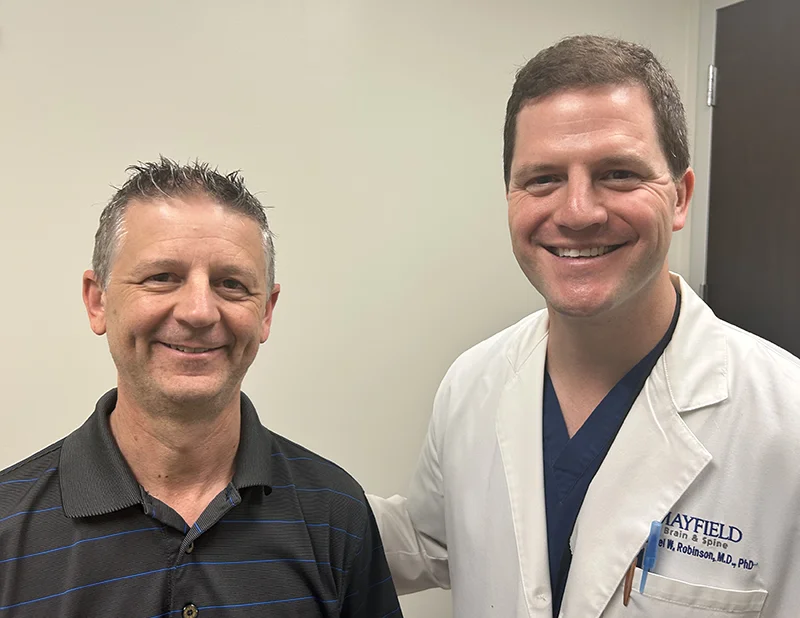
Dave with Dr. Robinson
About nine weeks after his stroke, Dave underwent a second surgery. Dr. Robinson placed a stent in his right interior carotid artery – the side opposite his initial stroke – which was nearly 80% blocked. That will further reduce the risk of any future stroke.
Today, Dave is back to work as an information technology manager. He’s jogging again and feeling fortunate.
“For a while, I think my body was adjusting to the stroke. I would get tired, and I would get mentally tired as well,” he says. “It’s God’s grace, just the fact that I fell and had so many people around. I feel like it’s a miracle.”
~ Cliff Peale
Hope Story Disclaimer -"Dave's Story" is about one patient's health-care experience. Please bear in mind that because every patient is unique, individual patients may respond to treatment in different ways. Results are influenced by many factors and may vary from patient to patient.
 Click here to call 513-221-1100