

Mary's story
Lumbar stenosis, radiculopathy, decompression surgery
After 65 years, Mary comes back to Mayfield for surgery
Mary remembers the first time she had back surgery with Mayfield Brain & Spine - in 1960.
Only in her 20s, Mary had the surgery to remove a benign tumor on her spinal cord at the former St. Luke Hospital in Fort Thomas. The surgery was performed by Dr. Edgar Lotspeich, one of the founders of the neurosurgical practice that would become Mayfield Brain & Spine.
"We got it fixed, and that was the end of it," Mary says. "Before the operation, it was terrible, terrible pain, but it wasn't as bad as it was before the most recent surgery."
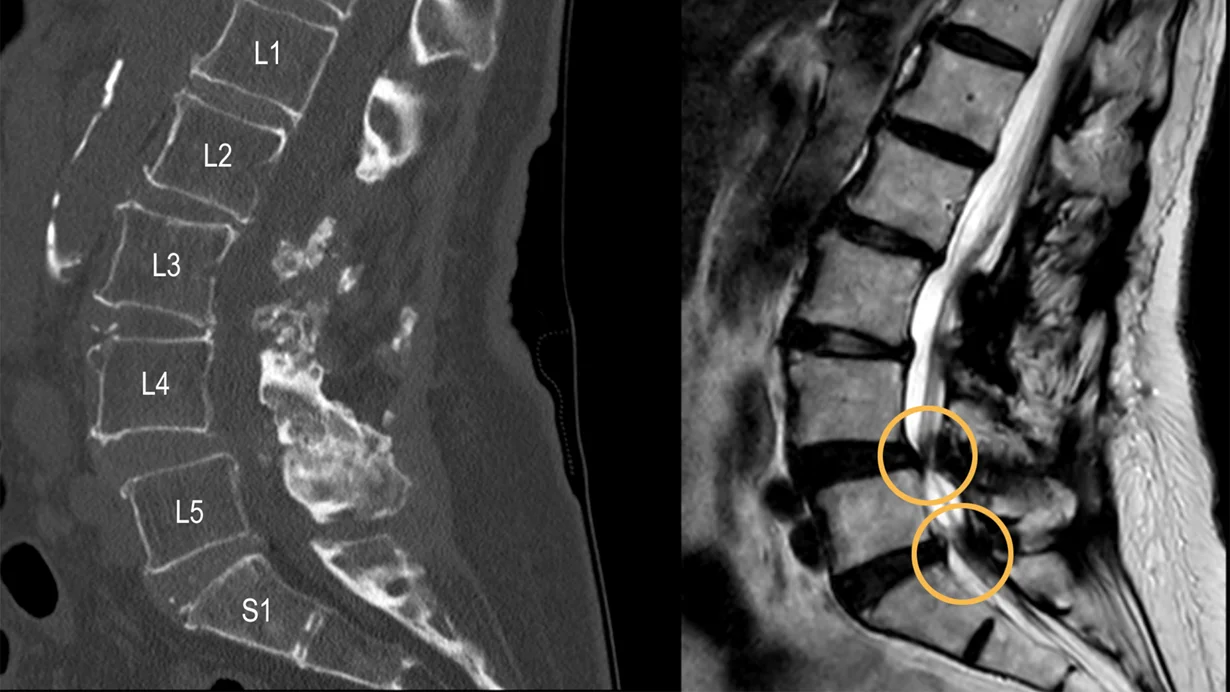
Mary's scans showning nerve compression in the lumbar spine
Her latest surgery came in December 2025 at The Christ Hospital. Mary is 91 now, and what she describes as "constant electric type of pain" was radiating from her hip and lower back down her left leg. Neurosurgeon Dr. Juan Mejia performed an operation that created space at the L4-L5 and L5-S1 levels of Mary's lumbar spine, easing pressure on the surrounding nerves.
In the six decades between her surgeries, Mary lived an active life without much pain. She drove a school bus for 30 years and had five children. She is still driving herself and attends cardio classes three times a week.
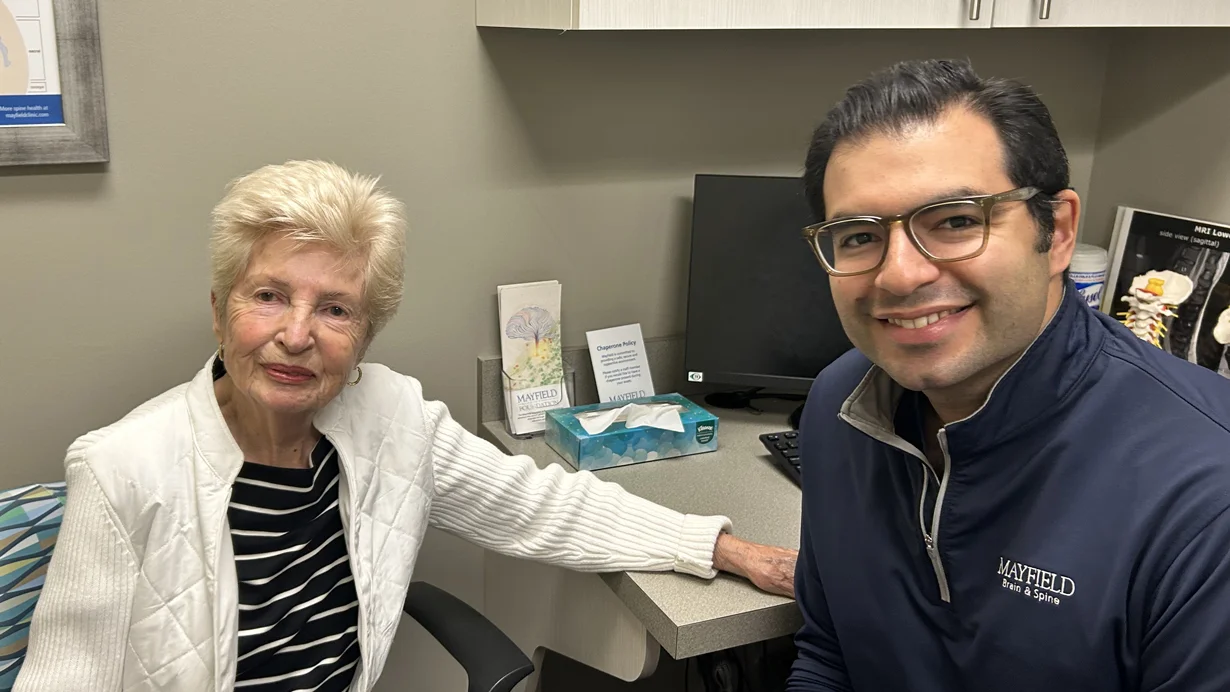
Mary with Dr. Mejia
While surgery for patients in their 90s is rare and requires careful consideration, Dr. Mejia says selected individuals at this age can still benefit from less invasive procedures when they are otherwise active and experiencing significant pain that limits their quality of life. The key, he says, is balancing safety with the opportunity to restore function and independence.
Mary says she needed that opportunity. She tried physical therapy and acupuncture. She received epidural steroid injections. It got to the point where the symptoms were overwhelming her daily life.
Mary took a similar attitude into both of her surgeries.
"I wasn't nervous at all. Heck no," she says. "I had to get it fixed. I couldn't live like that anymore."
Once Mary made it clear that she wanted to pursue treatment, Dr. Mejia completed a thorough preoperative evaluation to ensure she was an appropriate candidate, including any other medical conditions. Given these factors, Dr. Mejia determined that she was not a candidate for a larger fusion procedure, where a surgeon removes a disc and then fuses two vertebrae together.
Mary also suffered from spondylolisthesis, colloquially known as a "slipped disc." Recent studies have suggested that some patients can achieve meaningful relief with decompression surgery alone, avoiding the added risks of fusion. With this in mind, Dr. Mejia selected a smaller, targeted decompression tailored to Mary's condition.
"Every patient who comes to us for care deserves individual diagnosis and treatment, based on their individual pathology and their goals for treatment," Dr. Mejia says. "Mary was clear that she didn't want to suffer with her symptoms any longer. Once we determined that she could safely navigate the procedure and recovery, we went ahead with the surgery."
The day after the surgery, Mary walked the length of a football field in the hospital hallway, and she remains determined to live the same active lifestyle.
"I wasn't going to live like that," Mary says. "Dr. Mejia gave me back the rest of my life."
~ Cliff Peale
Hope Story Disclaimer -"Mary's Story" is about one patient's health-care experience. Please bear in mind that because every patient is unique, individual patients may respond to treatment in different ways. Results are influenced by many factors and may vary from patient to patient.
 Click here to call 513-221-1100