
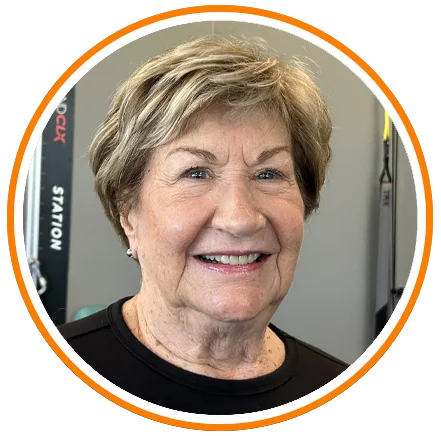
Carol's story
Chronic low back pain, physical therapy
Physical therapy instead of surgery helps Carol relieve pain and build strength
"I'm the type of person who thinks that if I feel good today, I'm going to feel good forever," Carol says. "But this time, I knew I'd really done a number on my back."
Last spring, Carol raked her yard and about a dozen bags with leaves. Before long, she felt pain in her lower back. She was soon referred to Dr. Juan Mejia, a neurosurgeon at Mayfield Brain & Spine's Anderson Township office.
Dr. Mejia reviewed full-length standing X-rays of Carol's spine with her. They showed mild scoliosis (an unnatural curve of the spine) and degenerative changes (arthritis of the discs and joints) throughout her lower back.
Because Carol's pain was confined to her lower back and did not radiate down her legs, there was no sign of the severe nerve compression that might call for surgery, Dr. Mejia says. He recommended a full course of physical therapy, with pain injections if needed.
"Carol's pain appeared to come from a lumbar strain, an overstretching or tearing of the muscles that support the spine, rather than any significant pressure on the spinal nerves," Dr. Mejia says. "In cases like this, patients are best served by physical therapy, which can relieve pain and restore daily function without surgery."
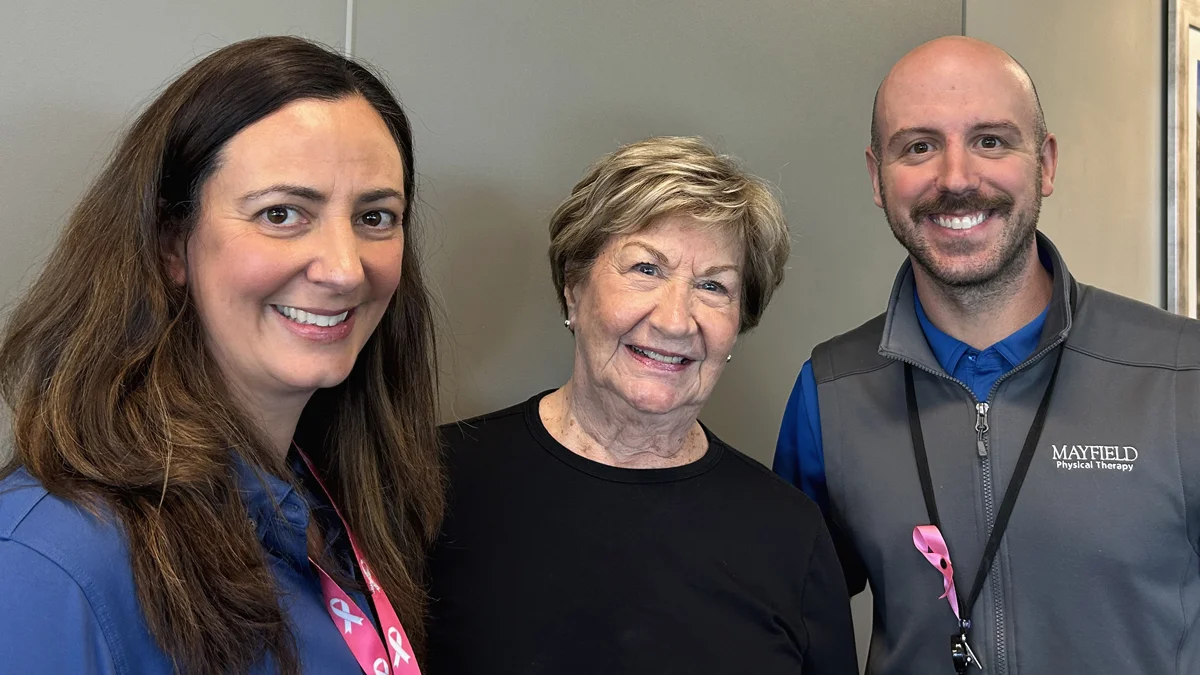
Carol with Lisa Craig, PTA and Luke Iding, PT
That's when Carol met physical therapist Luke Iding and PT assistant Lisa Craig. They started her on a stretching and strengthening program designed to stabilize her spine, relieve her pain and get her back to full activity. Her treatment also included massage, dry needling and TENS therapy, which uses a small, battery-operated device to send mild electrical currents that block pain signals.
"From Carol's first visit, our main goal was to get her moving again without pain," Craig says. "We worked to stimulate and relax the muscles around the affected area, used dry needling to increase blood flow and focused on strengthening her core. For patients who don't need surgery, these techniques can build strength and get them back to the activity level they can enjoy."
Carol continues her exercises at home. Because physical therapy has significantly reduced her pain, she hopes to continue treatment beyond the end of the year. She still lives with some pain most days, but she's hopeful that therapy can come close to eliminating it.
"It's getting better," Carol says. "I went in saying, 'I want everything on the menu.' They really listened to me and wanted my input. It's just a really positive atmosphere."
~ Cliff Peale
Hope Story Disclaimer -"Carol's Story" is about one patient's health-care experience. Please bear in mind that because every patient is unique, individual patients may respond to treatment in different ways. Results are influenced by many factors and may vary from patient to patient.
 Click here to call 513-221-1100