

Ann's story
Hemifacial spasm, Microvascular decompression
Clear diagnosis, intricate brain surgery relieve Ann's facial spasms
“He gave me my life back,” patient says.
As the spasms in her face worsened, Ann just wanted someone to believe in her.
A blizzard of appointments with doctors had produced few results. When the spasms first started two years ago, she thought it might be her sinuses. Then, after her eyes swelled shut, she thought she might be having a stroke. More recently, the spasms returned and affected her mouth and neck, leaving her unable to speak when they were happening. She even had trouble breathing, and her blood pressure was elevated. She says the spasms occurred every day and several hours each time.
Doctors told her it might all be in her head and that the brain would help repair itself.
"I knew I was not making this happen," Ann recalls. "Everybody just said, 'Oh, it's stress.' But I knew it was more than that."
Dr. Soliman Oushy, a neurosurgeon at Mayfield Brain & Spine, says that can be a common challenge for patients experiencing unfamiliar symptoms.
"Patients always want to know the source of their pain or discomfort, and when there is no clear diagnosis, that's incredibly difficult for the patient," says Dr. Oushy, who eventually performed an open brain surgery at The Christ Hospital.
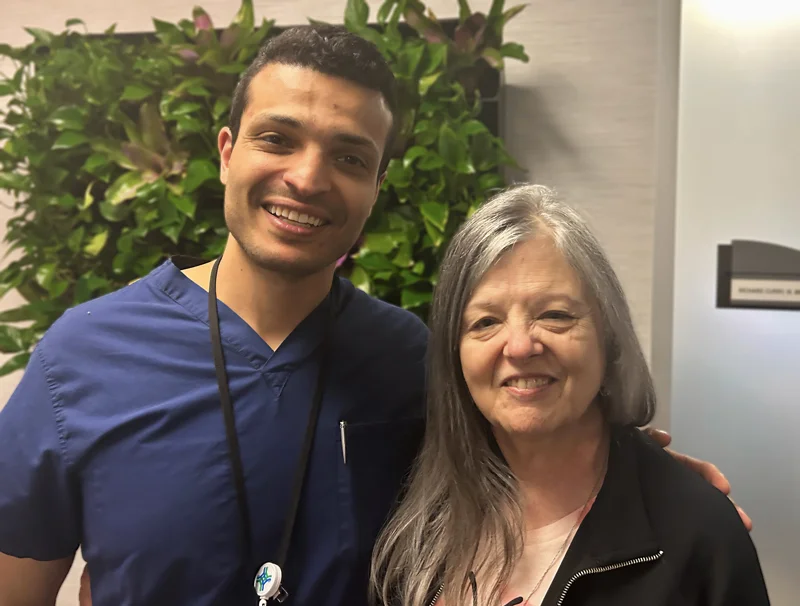
Ann with Dr. Oushy
After the symptoms worsened in recent months, Ann was referred to Mayfield, the nationally known independent practice based in Cincinnati. She first consulted with neurovascular specialist Dr. Robert James, who recognized the problem as hemifacial spasms, a disorder marked by twitching or movement on one side of the face. The spasms are caused by blood vessels pressing on the nerves that control movement in the face. In Ann's case, they were starting above the right ear and extending downward, making it difficult to smile or speak.
Ann didn't know anything about hemifacial spasms, but she was relieved to finally have someone who recognized her symptoms and identified a cause.
"He was the first person who validated what I was feeling," Ann says of Dr. James.
Dr. James referred Ann to Dr. Oushy, a fellow Mayfield neurosurgeon with advanced training in treating the intricate network of tiny veins, arteries and blood vessels inside and around the brain. Ann experienced one of the spasms during an appointment with Dr. Oushy, making the symptoms clear.
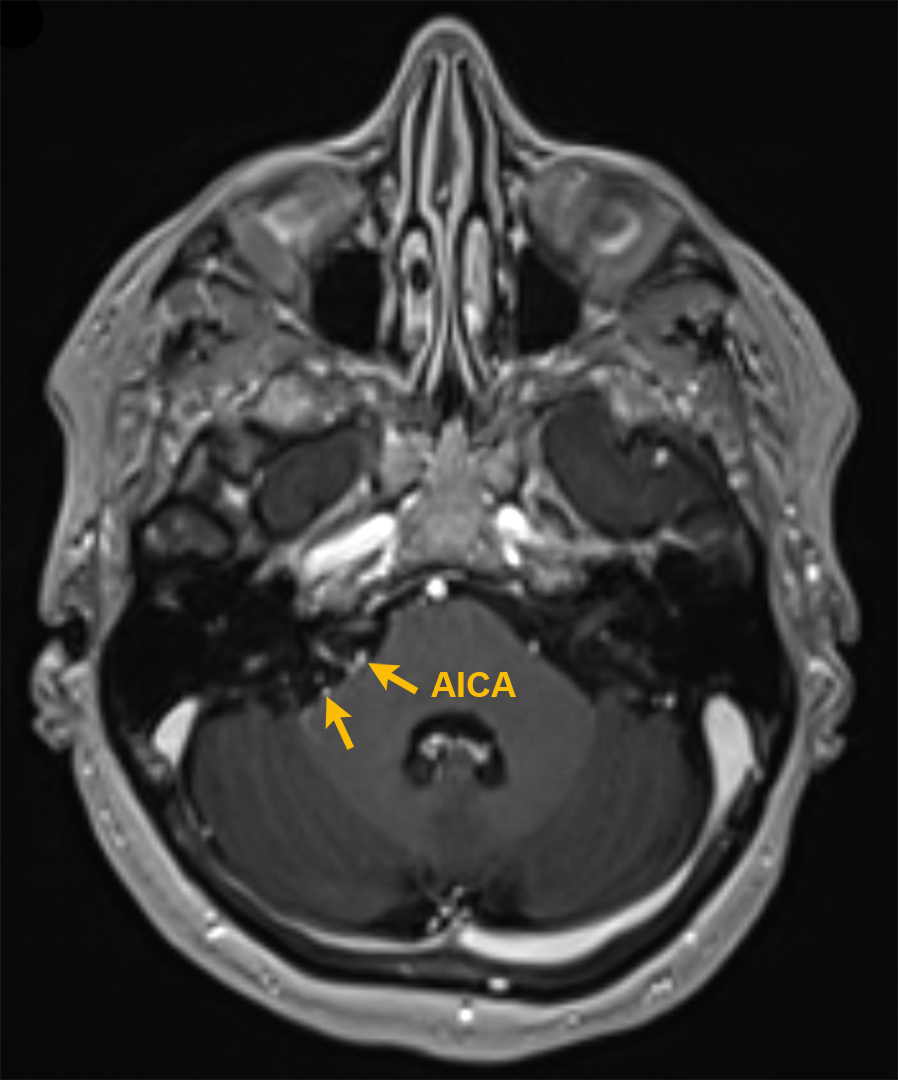
Dr. Oushy recognized a "vascular loop," where a small artery in the brain, called the anterior inferior cerebellar artery, was impinging on the root entry zone of the facial nerve near the brainstem.
Ann wanted immediate relief from her symptoms, so she advocated for microvascular decompression surgery, or MVD, to relieve pressure on the nerve root. Dr. Oushy recognized that the procedure would be significantly more difficult than in most cases, because of the extreme displacement of the nerve and the surrounding vascular anatomy. He needed to mobilize the blood vessel without causing any blockage or bleeding.
"Ann's imaging showed that the anterior inferior cerebellar artery was burrowing directly into the origin of the nerve at the brainstem, and there were multiple perforators in the region that could tear it away from the surrounding tissue," Dr. Oushy says. "This increased both the risks and duration of the surgery. We felt that we could free the artery from the surrounding vasculature without an ischemic event."

That was music to Ann's ears, just knowing that her symptoms were identified and that someone could help. Six weeks after the surgery, she hasn't experienced any facial spasms.
"Dr. Oushy believed me, and he had faith that he could fix me," Ann says. "I just knew I was in the right place at the right time."
~ Cliff Peale
Hope Story Disclaimer - "Ann's story" is about one patient's health care experience. Please bear in mind that because every patient is unique, individual patients may respond to treatment in different ways. Results are influenced by many factors and may vary from patient to patient.


 Click here to call 513-221-1100